
.svg)

Lens Guide for the Pantanal: What Focal Length Do You Really Need?
Lens Guide for the Pantanal: What Focal Length Do You Really Need?
When you’re photographing jaguars in the Pantanal, the right focal length matters more than the brand of your camera. Distances can shift fast — one minute you’re 50 meters from a jaguar on an open bank, and the next it’s walking straight toward your boat.
Here’s the simple, realistic breakdown for every budget and every style.
400mm vs 600mm: What's the Difference? (Without Saying One Is Better)
Both 400mm and 600mm lenses are excellent in the Pantanal — the choice depends on your style, your shooting preferences, and the distance of the sighting, not on which one is “best.”
400mm
Pros:
- Wider field of view for behaviour and storytelling
- Easier to track fast movement
- Lighter and faster to handle
- Perfect for close encounters and action
Cons:
- Can feel short when the jaguar is across a wide river channel
- Harder to isolate a subject in busy vegetation
600mm
Pros:
- Fantastic reach across the river
- Ideal for shy, distant, or resting jaguars
- Beautiful subject isolation
- Great for tight portraits and fine detail
Cons:
- Narrower field of view
- Heavier
- Can be too tight when the cat suddenly approaches the boat
The Real Point:
Neither focal length is “better.” They simply shine in different scenarios.
Real Photographer Example (Your Personal Setup)
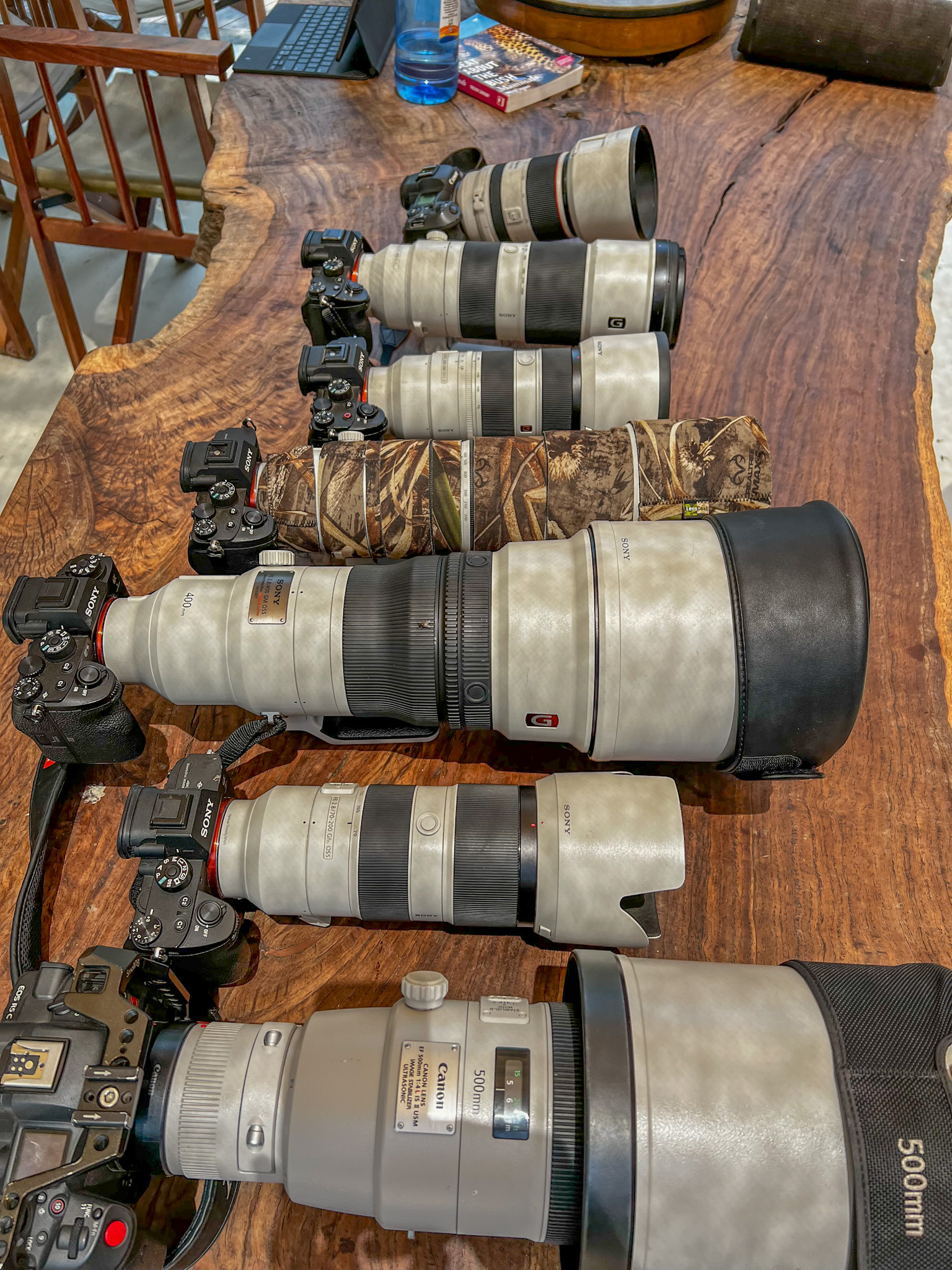
I personally use a 400mm prime, and it covers 95% of my shooting in the Pantanal.
When I want something wider — like a jumping jaguar, a tree descent, or a close-range behavioural moment — I switch to a 70–200mm f/2.8.
This combination lets me shoot:
- Tight portraits
- Fast action
- Environmental storytelling
- Behaviour sequences
- Close encounters
- Distant banks
It’s a balanced setup, but again — it depends on your style and what you enjoy shooting most.
Budget-Friendly & Practical Alternatives
Not everyone is bringing two giant primes, and that’s completely fine. You can absolutely get incredible jaguar photos with more affordable zooms.
Here are realistic, powerful options:
Sony Shooters
- 200–600mm f/5.6–6.3 → The most versatile single lens for the Pantanal
- 100–400mm → Great for behaviour and closer encounters
- 70–200mm f/2.8 → Surprisingly useful when the cat is near the boat
Canon Shooters
- RF 100–500mm → One of the most flexible and lightweight wildlife zooms
- RF 70–200mm 2.8 → Perfect for close action and environmental frames
Nikon Shooters
- Z 180–600mm → Incredible value and excellent for the Pantanal
- Z 100–400mm → Sharp, lightweight, great for dynamic scenes
- 70–200mm 2.8 → Same as above — awesome for close encounters
Even a 70–200mm 2.8 Alone?
You’ll get plenty of great photos — especially if you love behaviour, compositions, and close-range moments.
But in many scenarios you’ll wish for more reach, especially when jaguars stay on distant banks or deep in vegetation.
Still, it’s absolutely workable.
Practical Bottom Line (Balanced & Inclusive)
You don’t need a specific focal length to photograph jaguars — you need something that fits your style and your budget.
- 400mm gives you flexibility, behaviour, and storytelling.
- 600mm gives you reach, detail, and isolation.
- 100–400mm / 180–600mm / 200–600mm lenses give you coverage for almost everything at a more affordable price.
- 70–200mm is brilliant when the cat is close or when you want big-environment compositions.
Any of these setups can deliver world-class Pantanal images.
If you bring two lenses, a wide telephoto (70–200 or 100–400) paired with a longer telephoto (400mm, 500mm, 600mm, or a 200–600) gives you the most flexibility for every scenario — from distant hunts to boat-side encounters.
What Else Should You Bring for a Pantanal Photography Trip?
Lens choice is only one part of being prepared. The Pantanal is hot, humid, and unpredictable — and you’ll be on the river all day. Here’s the essential gear every photographer should pack:
Laptop for Backing Up Photos
You’ll shoot thousands of images per day. Bring a lightweight laptop so you can
- back up your files each night,
- review selects, and
- keep your memory cards fresh for the next morning.
Lightroom is ideal for quick sorting.
External Hard Drive (Atleast 1TB)
Back up every single day.
The Pantanal is not the place to risk losing your only copy of a once-in-a-lifetime jaguar encounter.
Rugged drives SanDisk Extreme are perfect.
Memory Cards (Bring More Than You Think)
High-speed SD cards are essential.
Plan for 1 per day, depending on burst shooting.
Tip: Use multiple smaller cards rather than one giant one. If a card fails, you won’t lose an entire trip’s worth of images.
Spare Batteries
We’re on the river all day, and you don’t want to be swapping batteries during an action moment.
Bring: At least 1 spare battery depending on your camera.
Mirrorless systems drain faster in heat and humidity.
Camera Bag (Small, Soft, Waterproof)
Hard cases = too big for boats.
Giant backpacks = take up floor space you need for pivoting and shooting.
Bring a compact, soft, water-resistant bag that:
- fits under your seat,
- holds your essentials,
- can handle humidity and spray.
I’ve used LowePro, Shimoda, F-Stop, and several others over the years — but Gura Gear is, without question, the best camera bag in the world.It’s incredibly lightweight, fits perfectly in the boat, and is designed for photographers who travel hard and shoot fast. Nothing else comes close for Pantanal conditions.
Why We Don’t Use Tripods in the Pantanal
Tripods are amazing on land — but on a boat, they’re almost useless.
Here’s why:
1. They Take Up Too Much Space
The boat is narrow. You need room to pivot, kneel, twist, and shoot quickly in all directions.
2. They Don’t Stabilise Anything
A tripod on a boat doesn’t stop motion.
The boat is moving. The water is moving. You are moving.
All a tripod does is transfer vibration straight into your camera.
You’re effectively handheld all day, no matter what.
3. They Slow You Down
Jaguars don’t wait for you to unlock a clamp or re-level a leg.
You need to react instantly when something happens — especially jumps, climbs, and hunts.
Verdict:
Leave the tripod at home. You won’t use it.
A Monopod or Beanbag?
Monopod
Useful only for long, slow sightings or very heavy primes.
Still transfers vibration into your camera, and limits your movement.
Beanbag (Highly Recommended)
A small, soft beanbag works beautifully for:
- absorbing vibration
- resting your lens
- steady panning
A simple pillow-style beanbag is perfect and takes almost no space. However, remember that the boat is always moving, and you’re constantly changing angle to follow the jaguar. A beanbag is great for resting the camera and it will definitely come in handy for certain shots — but don’t rely on it as your main support. In the Pantanal, you’re essentially handheld all day.
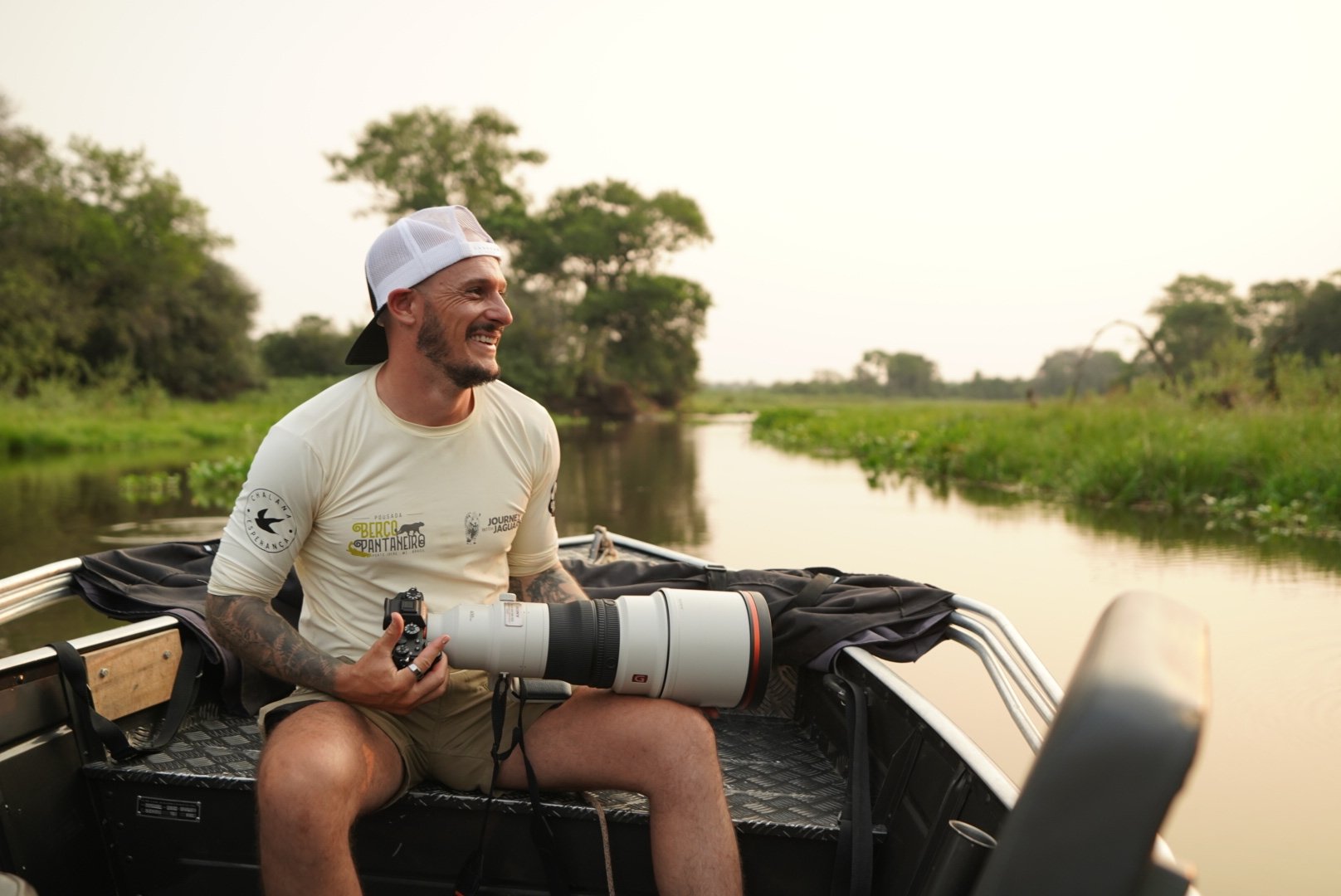
Ex-Professional Jockey | Founder @ Journey with Jaguars | Jaguar Safaris, Brazilian Pantanal | Wildlife Photographer | Director @ CLIC Foundation
.png)
Step into the wild
Exclusive trip updates, rare jaguar stories, and insider photography tips - straight to your inbox!